
A quality framework for care homes for adults and older people

Introduction
The primary purpose of this quality framework is to support services to evaluate their own performance. It is then used by inspectors to provide independent assurance about the quality of care and support. By setting out what we expect to see in a high-quality service, we can also help support improvement.
Within the framework we have included a scrutiny toolbox, which provides examples of the scrutiny actions we may use in evaluating the quality of provision. The resources below are key practice documents that we think will help care services in their own improvement journey. These are listed under each relevant key question.
We have also produced a set of self-evaluation tools to support services to assess how well they are doing against key areas from our quality framework and highlight where they need to support improved outcomes for people.
Since 1 April 2018, the Health and Social Care Standards have been used across Scotland. They were developed by Scottish Government to describe what people should experience from a wide range of care and support services. They are relevant not just for individual care services, but across local partnerships. The Care Inspectorate’s expectation is that they will be used in planning, commissioning, assessment and in delivering care and support.
We use these standards to inform the decisions we make about quality of care and support, and since their introduction we have been developing new approaches to scrutiny. This has been to ensure our inspections and other scrutiny work are strongly focused on assessing the extent to which people experience wellbeing, and on understanding the difference care and support makes to their lives.
Our approaches to scrutiny ensure there is an emphasis on experiences and outcomes; proportionate approaches in services that perform well; shorter inspection reports; and a focus on supporting improvement in quality. The core of this approach is a quality framework that sets out the elements that will help us answer key questions about the difference care is making to people and the quality and effectiveness of the things that contribute to those differences.
The primary purpose of a quality framework is to support services to evaluate their own performance. The same framework is then used by inspectors to provide independent assurance about the quality of care and support. By setting out what we expect to see in a high-quality service, we can also help support improvement. Using a framework in this way develops a shared understanding of what constitutes good care and support. The quality framework also supports openness and transparency in the inspection process.
In developing it, we have involved both people who experience or have experienced care and those who provide care and support. It is based on the approach used by the European Foundation for Quality Management (EQFM), specifically the EFQM Excellence Model, which is a quality tool widely used across sectors and countries. We have adapted the model for use in care settings and have used the Health and Social Care Standards to illustrate the quality we expect to see. Our frameworks are tested and evaluated to hear the views of people experiencing care, their carers and care providers. They are also kept under review to ensure they reflect any changes in the wider social care landscape. All of this helps us refine our frameworks and the way we use them.
Previously, we had separate quality frameworks for care homes for adults and care homes for older people. This revised quality framework now covers care homes for both adults and older people which provide a range of different supports to different people with a wide variety of needs and outcomes. The quality framework is framed around six key questions. The first of these is:
How well do we support people’s wellbeing?
To try and understand what contributes to that, there are four further key questions:
How good is our leadership?
How good is our staff team?
How good is our setting?
How well is our care planned?
Under each key question, there are up to five quality indicators. These have been developed to help answer the key questions. Each quality indicator has key areas, short bullet points which make clear the areas of practice covered by it.
Under each quality indicator, we have provided quality illustrations of these key areas at two levels on the six point scale that we use in inspections. The illustrations are the link to the Health and Social Care Standards and are drawn from the expectations set out in these. They are also aligned to the appropriate legislation and relevant national good practice. They describe what we may expect to see in a care service that is operating at a ‘very good’ level of quality, and what we might see in a service that is operating at a ‘weak’ level of quality. These illustrations are not a definitive description of care and support provision but are designed to help care and support services and inspectors evaluate the quality indicators using the framework.
The final key question is:
What is our overall capacity for improvement?
This requires a global judgement based on evidence and evaluations from all other key areas. The judgement is a forward-looking assessment, but also takes account of contextual factors which might influence the capacity of an organisation to improve the quality of services in the future. Such factors might include changes of senior staff, plans to restructure, or significant changes in funding. We think this an important question to ask as part of a self-evaluation of care.
You should carefully consider the aims and objectives of your service when looking at the quality illustrations and evaluating it using the quality indicators and key questions. In each quality indicator, we have included a scrutiny and improvement toolbox. This includes examples of the scrutiny actions that the Care Inspectorate may use in evidencing the quality of provision. It also contains links to key practice documents that we think will help care services in their own improvement journey.
Our inspectors will look at a selection of the quality indicators. Which, and how many quality indicators, will depend on the type of inspection, the quality of the service, the intelligence we hold about the service, and risk factors that we may identify. We will use the quality illustrations, which are based on the Health and Social Care Standards, in our professional evaluations about the care and support we see. During the Covid-19 pandemic we introduced an additional key question to the framework. Key question 7 focused on ‘how good is our care and support during the Covid-19 pandemic?’.
This key question is no longer a part of the framework, however one of the quality indicators 1.5, has been developed to ensure that where there are outbreaks of any infectious diseases, people’s health and wellbeing continues to be supported and safeguarded by infection, prevention and control practices.
Our inspectors will look at a selection of the quality indicators. Which, and how many quality indicators, will depend on the type of inspection, the quality of the service, the intelligence we hold about the service, and risk factors that we may identify. We will use the quality illustrations, which are based on the Health and Social Care Standards, in our professional evaluations about the care and support we see. During the Covid-19 pandemic we introduced an additional key question to the framework. Key question 7 focused on ‘how good is our care and support during the Covid-19 pandemic?’. This key question is no longer a part of the framework, however one of the quality indicators 1.5, has been developed to ensure that where there are outbreaks of any infectious diseases, people’s health and wellbeing continues to be supported and safeguarded by infection, prevention and control practices.
This reflects our learning from issues relating to infection, prevention and control that arose during the pandemic, and takes into account the National Infection Prevention and Control Manual for older people and adult care homes.
In addition to the evaluating key questions, there are some things we will always look at on our inspections. This is because we know that these key areas are essential to a service being safe. We call these ‘core assurances’.
The six-point scale is used when evaluating the quality of performance across quality indicators.
6 - Excellent: Outstanding or sector leading
An evaluation of excellent describes performance which is sector leading and supports experiences and outcomes for people which are of outstandingly high quality. There is a demonstrable track record of innovative, effective practice and/or very high quality performance across a wide range of its activities and from which others could learn. We can be confident that excellent performance is sustainable and that it will be maintained.
5 - Very good: Major strengths
An evaluation of very good will apply to performance that demonstrates major strengths in supporting positive outcomes for people. There are very few areas for improvement. Those that do exist will have minimal adverse impact on people’s experiences and outcomes. While opportunities are taken to strive for excellence within a culture of continuous improvement, performance evaluated as very good does not require significant adjustment.
4 - Good: Important strengths, within some areas for improvement
An evaluation of good applies to performance where there is a number of important strengths which, taken together, clearly outweigh areas for improvement. The strengths will have a significant positive impact on people’s experiences and outcomes. However improvements are required to maximise wellbeing and ensure that people consistently have experiences and outcomes which are as positive as possible.
3 - Adequate: Strengths just outweigh weaknesses
An evaluation of adequate applies where there are some strengths, but these just outweigh weaknesses. Strengths may still have a positive impact but the likelihood of achieving positive experiences and outcomes for people is reduced significantly because key areas of performance need to improve. Performance which is evaluated as adequate may be tolerable in particular circumstances, such as where a service or partnership is not yet fully established, or in the midst of major transition. However, continued performance at adequate level is not acceptable. Improvements must be made by building on strengths while addressing those elements that are not contributing to positive experiences and outcomes for people.
2 - Weak: Important weaknesses, priority action required
An evaluation of weak will apply to performance in which strengths can be identified but these are outweighed or compromised by significant weaknesses. The weaknesses, either individually or when added together, substantially affect people’s experiences or outcomes.
Without improvement as a matter of priority, the welfare or safety of people may be compromised, or their critical needs not met. Weak performance requires action in the form of structured and planned improvement by the provider or partnership with a mechanism to demonstrate clearly that sustainable improvements have been made.
1 - Unsatisfactory: Major weaknesses, urgent remedial action required
An evaluation of unsatisfactory will apply when there are major weaknesses in critical aspects of performance which require immediate remedial action to improve experiences and outcomes for people. It is likely that people’s welfare or safety will be compromised by risks which cannot be tolerated. Those accountable for carrying out the necessary actions for improvement must do so as a matter of urgency, to ensure that people are protected, and their wellbeing improves without delay.
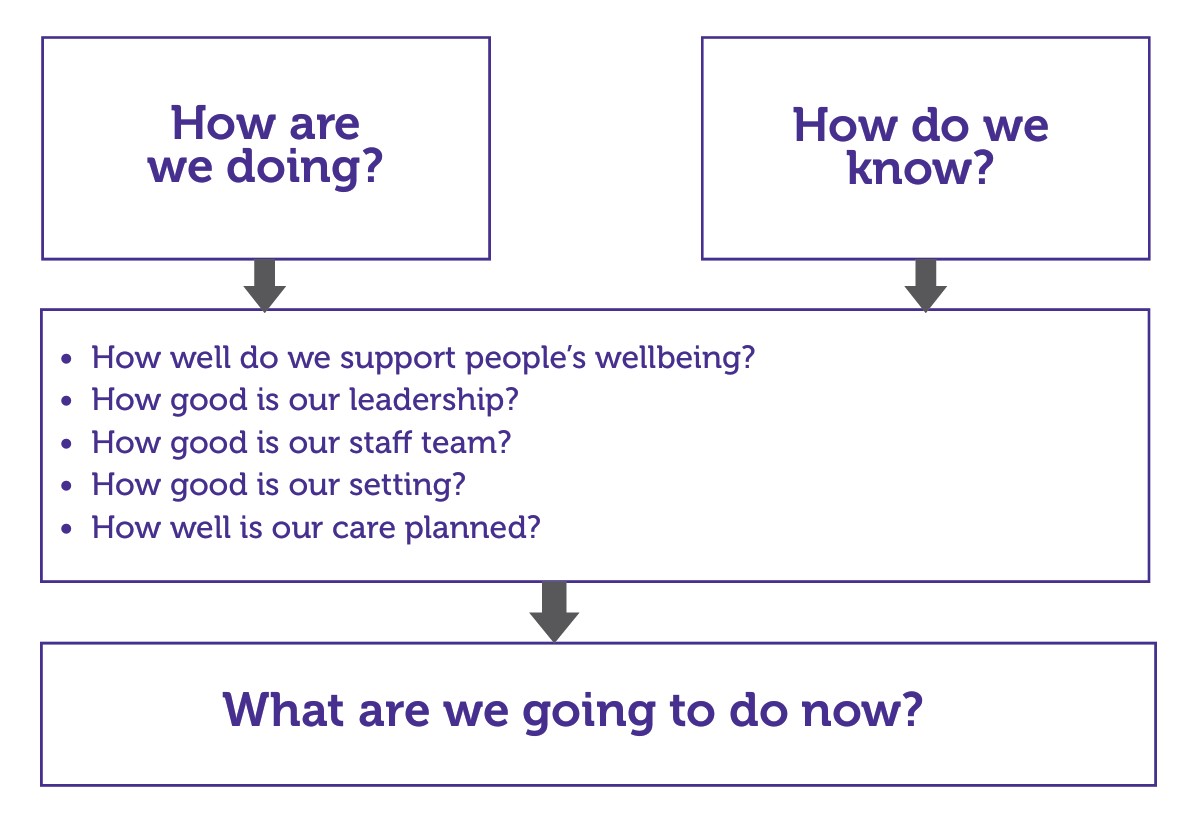
The framework is primarily designed to support care services in self-evaluation. Self evaluation is a core part of assuring quality and supporting improvement. The process of self-evaluation, as part of a wider quality assurance approach, requires a cycle of activity based round answering three questions:
How are we doing?
This is the key to knowing whether you are doing the right things and that, as result, people are experiencing high quality, safe and compassionate care and support that meets their needs, rights and choices.
How do we know?
Answering the question ‘how we are doing?’ must be done based on robust evidence. The quality indicators in this document, along with the views of people experiencing care and support, and their carers, can help you to evaluate how you are doing. You should also take into account performance data collected nationally or by your service.
What are we going to do now?
Using this quality framework can help provide an effective structure around self-evaluation. To help you with this, we have also developed a self-evaluation tool with guidance that you can use alongside this framework to support improvement.
Irrespective of our role as the national scrutiny and improvement body, care providers will want to satisfy themselves, their stakeholders, funders, boards and committees that they are providing high quality services. We believe this quality framework is a helpful way of supporting care and support services to assess their performance and make improvements as part their own quality assurance. We are promoting this approach as we believe it adds value, and we consider it important that care and support providers do not take actions merely to satisfy the inspection process.
Key question 1: How well do we support people’s wellbeing?
1.1. People experience compassion, dignity and respect
1.2. People get the most out of life.
1.3. People’s health and wellbeing benefits from their care and support
1.4. People experience meaningful contact that meets their outcomes, needs and wishes
1.5. People’s health and wellbeing benefits from safe infection prevention and control practices and procedures
Key question 2: How good is our leadership?
2.1. Vision and values positively inform practice
2.2. Quality assurance and improvement is led well
2.3. Leaders collaborate to support people
2.4. Staff are led well
Key question 3: How good is our staff team?
3.1. Staff have been recruited well
3.2. Staff have the right knowledge, competence and development to care for and support people
3.3. Staffing arrangements are right and staff work well together
Key question 4: How good is our setting?
4.1. People experience high quality facilities
4.2. The setting promotes people’s independence
4.3. People can be connected to and involved in the wider community
Key question 5: How well is our care and support planned?
5.1. Assessment and personal planning reflects people’s outcomes and wishes
5.2. Carers, friends and family members are encouraged to be involved