
Quality improvement tools and resources
Quality improvement is the term used to cover specific activities that can improve the quality of care. The aim of improvement activity in care services is to make the care you provide better. That might be safer (less errors, infections, falls), more effective, more efficient (less waste) or more person-centred (caring, compassionate, fitting with resident/family wishes). Quality improvement involves individuals, teams and organisations looking at how making changes to the way they work can improve care. Improving care is often about changing habits. Sometimes a small change can make a huge difference. Making improvements should benefit your residents, your staff and the organisation.
Key things to remember
The aim of improvement activity in your service is to make the care you provide better
Improvement in the quality of care doesn’t happen by accident; it needs to be planned and structured and takes time
Making improvements should benefit everyone
Essentials for achieving successful improvements include a belief that there is always the potential to improve, strong leadership, support, adequate resources, a dedicated improvement team and making improvement everyone’s business
A well-planned approach to improvement will give you a better chance of being successful and maintaining improvements
The Model for Improvement is a tried and tested approach to achieving positive change
Consideration needs to be given to how improvements will last in the longer term
Self-evaluation bite size videos
Self-evaluation supports services to evaluate how good they are and what needs to improve, leading to better outcomes for people who experience care. The Care Inspectorate has produced a toolkit to help services establish self-evaluation in practice. The short videos give an overview of the self-evaluation process and covers all of the three questions: How are we doing? How do we know? and What are we going to do next?
They give ideas on how to get started, what evidence you need, and how to get meaningful feedback that will help you evaluate how good your service is. They provide information to help you establish an improvement plan and give some helpful tips to help you get started with your self-evaluation improvement journey.
A structured approach to improvement
A well-planned, structured approach to improvement will give you a better chance of being successful. The first step is to identify where changes can be made in your service to improve care.
The image below summarises a structured approach to improvement we recommend. The first step is to identify where changes can be made in your service to improve care.
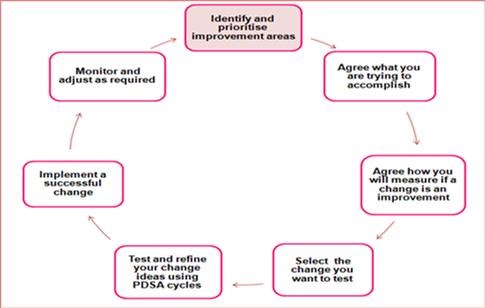
The model for improvement
This model offers the following benefits:
It is a simple approach that anyone can apply
It reduces risk by starting small
It can be used to help plan, develop and implement change
It is highly effective
What is the model for improvement?
The model for improvement provides a framework for developing, testing and implementing changes to the way that things are done that will lead to improvement.
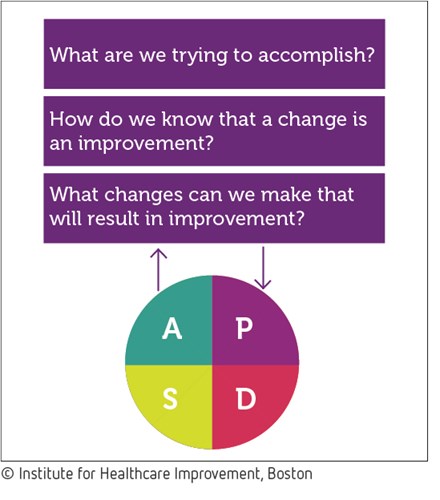
The model consists of two parts that are of equal importance. The first, the ‘thinking part’, consists of three fundamental questions that are essential for guiding improvement work.
The second part, the ‘doing part’, is made up of Plan, Do, Study, Act (PDSA) cycles that will help you make rapid change.
The three fundamental questions for achieving improvement provide a useful way to frame your improvement work.
What are the three fundamental questions for achieving improvement?
This question helps you to be clear about what you aim to achieve with your improvement activities. What will success look like in your care home? How will things be different? It is crucial for everyone involved to have a clear understanding of your aims.
While every improvement is a change, not every change results in improvement. Without measurement it is impossible to know whether things have improved. Agree what information you need to collect to measure whether or not the changes you make are improvements.
You can do this in terms of the way in which your results or outcomes might be different (for example, the number of falls in the care home), how the care that your residents receive will be better (for example, the number of residents receiving yearly eye health checks), or how your processes might change (for example, the number of residents receiving a multifactorial falls risk screen within 24 hours of admission).
A key element of successful improvement is collecting data which can be measured to show what improvement has taken place. If this is done by front line staff they see the changes that matter to people. They will then be motivated and inspired to identify and make improvements which will last.
How do you know that your improvements are making a difference?
Be clear about what it is you are measuring and that everyone is measuring the same thing in the same way
Be specific about roles and responsibilities of those collecting the information. Who does it and when?
Determine the frequency of data collection. Will it be collected daily and then displayed monthly? The data will need to be collected continuously over the life span of the improvement project
Understand the current state by taking a baseline before you test any changes
How have the changes you have tested impacted on your data? Is there any improvement?
Continue to review the data throughout testing to understand if the changes you are testing are resulting in achieving your aim
Finally, you need to decide what changes you will test to achieve the results you are looking for.
Consider:
Ideas and tools available in this resource that can improve care
Evidence you have from elsewhere about what is most likely to work
What you and your team think is a good idea
What other people have done that you could try
This is where you can adapt ideas or be completely creative. Remember that you know your own service best, so use your knowledge and experience to guide you.
Gather together as many ideas as you can. These will form the basis for the next step – your tests of change, otherwise known as PDSA cycles.
PDSA cycles
PDSA stands for ‘Plan, Do, Study, Act’. A PDSA cycle is sometimes referred to as a test of change. Once you have decided exactly what you want to achieve, you can use PDSA cycles to test out your ideas developed from the third question, ‘What changes can we make that will lead to an improvement?’
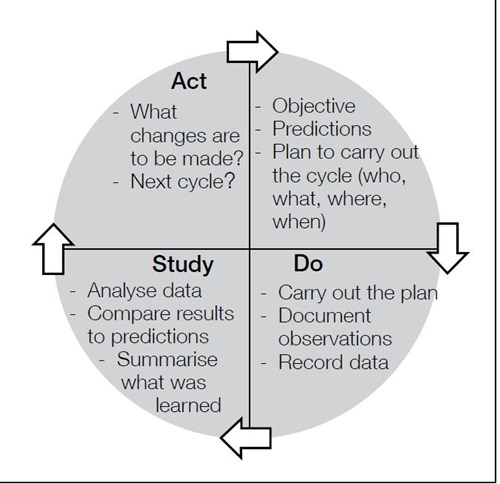
First ‘Plan’ your PDSA cycle - what, where, when and who. Think what information (data) you need to collect to learn whether or not your test is successful. Predict what you think will happen – reflecting on this later will help your learning.
The key is to try out your change on a small scale to begin with. You might, for example, like to run your cycle over one day, with one staff member or one service user. You can carry out a number of cycles to build up information about how effective your change is.
Taking this approach makes it easier to get started, gives results rapidly and reduces the risk of something going wrong and having a major impact. If what you try doesn’t work as well as you hoped, you can always go back to the way you did things before. When you have built up enough information to feel confident about your change, you can then implement it as part of the routine in your care service.
After you’ve carried out your Plan (‘Do’), the ‘Study’ part of the cycle gives you the opportunity to reflect on what happened, think about what you have learnt and build your knowledge.
Finally, you can move on to your next step – the ‘Act’ part of the cycle. Do you need to run the same cycle again, gathering more evidence or making some changes based on what you learnt? Or do you need to carry out further cycles to move your work forwards?
Always remember
Anyone can use them in any area
PDSAs cannot be too small
One PDSA will almost always lead to one or more others
You can achieve rapid results
PDSA cycles will help you to be thorough and systematic
PDSA cycles will help you learn from your work
How do you move from testing things out to implementation?
If the data gathered from the tests of change is showing consistent improvement, set a date for implementation. Make sure all staff know about the change, when it will happen, how it will happen and where it will happen. Involve staff in your care home throughout the process.
Update written guidance and policies to include any new way of working if appropriate.
Further tweaks may be required during the implementation phase using PDSAs. Regularly review any data and processes to ensure improvements do continue.
Remember effort will be required to ensure improvements are maintained over time.
Things to consider
Establish a local network of interested people to share knowledge, learning and ideas
Celebrate successes
Provide ongoing, supportive leadership
Always include all relevant information on improvements in your induction process
Keep everyone informed and involved and identify the best way to do this
Embed continuous improvement into the culture of your service
Your quality improvement and health and safety monitoring should include monitoring any improvements
Six essentials for successful improvement and things to consider
Consider anything specific to the problem area that would help such as raising awareness, learning and development sessions during induction, specific learning sessions and refreshers as appropriate. This would be on the topic area that required improvement such as medication matters, falls prevention, dementia.
Leadership and support from managers is vital but remember there are other members of staff who can provide effective leadership too.
Consider making contact with your wider health and social care team, other care services or champions in your area.
Consider the following resources:
Time to identify, test out and implement improvements
Staff to support the improvement process including administrative support
Equipment required
Staff training requirements
Any financial requirements
Time to learn how to use improvement tools if you think they will help you
Include a minimum of three staff members from your service. This shares responsibility, allows for leave and provides some continuity.
Identify an improvement team lead to provide leadership for improvement work. It may be helpful to identify team members as champions so staff are clear about their role.
Helpful links
Thank you for subscribing!