
How we inspect regulated services: guidance for providers of regulated care settings and the public
1 Introduction
At the Care Inspectorate, we regulate care services for people of all ages in Scotland. Our work includes registering services, inspecting and evaluating (grading) them, dealing with complaints, carrying out enforcement action where necessary, and helping services to improve.
We are also here to champion good quality care whenever we encounter it across the thousands of inspections we carry out each year. We work closely with all care providers to support them to improve all the time. We will collaborate and take action where experiences and outcomes are not meeting individuals’ needs.
Almost everyone in Scotland, at one time or another, will use a service that we regulate. We regulate around 10,500 care services offering many different kinds of care to people with a wide range of needs. It’s our job to regulate and inspect care services so that:
vulnerable people are safe
the quality of these services is high and continues to improve
people know the standards they have a right to expect
we can report publicly on the quality of these services across Scotland
we can support the review and development of how services are delivered.
We inspect a variety of care services including care homes and support/care services for older people, adults and children, fostering and adoption services, adult placement services, nurse agencies, early learning and childcare (ELC) registered under daycare of children, including school age childcare and childminders. Information about registered care services can be found within the care service register on our website. Statistical data about services is available in our data and statistics section.
When we inspect, our inspectors observe practice and engage with people using the service, staff and managers. We give care services evaluations (sometimes referred to as grades) when we inspect them, and look at key areas like how well care, play and learning are supported, how well services support people’s health and wellbeing and the quality of the setting, personal planning, staffing, leadership and management. Each quality indicator is assessed on a scale from one to six, where one is unsatisfactory and six is excellent. After every inspection, we publish an inspection report showing our findings. All our inspection reports are public documents for all to see.
2 Principles of inspection
The purpose of inspection is to give assurance about the quality of care, support and learning and promote improvements, so that people enjoy positive experiences and the best possible outcomes.
We recognise that inspections can be stressful for services. We aim to minimise any additional stress and undue anxiety for everyone involved.
Our inspectors therefore will:
conduct themselves professionally at all times in line with our core values, organisational and professional standards
maintain a high level of awareness of the context in which staff are operating, and of their feelings and reactions to the inspection process
ensure that every inspection is of high quality and responsive to the needs of people using services
identify strengths to celebrate the achievements of services
involve managers, staff, people who use the service, carers and other professionals in the inspection process
use the data and information we have about a service as the starting point for the inspection and to identify key issues to explore
gain the perspective of people using the service
make sure time is spent wisely to get the best possible evidence to identify the achievements of the service since the last inspection and support improvement
treat people with dignity and respect, engaging them in professional dialogue, recognising their efforts and sharing findings in a constructive way to encourage ownership and learning to take place
provide constructive professional feedback throughout the process to support continuous improvement
be clear with services about areas for improvement and requirements
ensure that evaluations are valid, proportionate and based on first-hand evidence, triangulated where possible
report confidently on the quality of the service and the experience of people using it and share good practice where appropriate.
3 Our approach to inspections
The frequency and timing of our inspections will depend on a number of factors, including our assessment of the information and data we hold about a service. Our inspections are unannounced as it is important we observe how services operate on a day to day basis and the outcomes people experience.
In exceptional circumstances, where a short notice inspection is the only appropriate option, services will typically get less than 24 hours’ notice. This does not apply to fostering and adoption services where inspections are announced four to six weeks in advance. Shared inspections with HMIE will have a lead in time of two and a half weeks, although arrangements may vary for services such as secure accommodation and mainstream boarding schools.
For services that only operate at set times, we will ask the provider to update us regularly on the operation of the service.
Core assurances
Core assurances are the key areas we consider when we register and inspect services and the policies and procedures relating to them, for example, protecting people or recruitment. Theory and inquiries into when care goes wrong has highlighted the areas that are important to monitor because these can be identified as early indicators of concern to people using services (Scottish Government 2014, Hull University 2012, Francis Report 2013).
Because we know, and research tells us, that these key areas are essential to a service being safe, we call them ‘core assurances’. We assess these at every inspection, with the exception of follow-up inspections.
The core assurances are published in most of our quality frameworks. They span the entire framework, covering elements of several different quality indicators. Where concerns arise from our assessment of a particular core assurance, we may increase the scope of the inspection by pulling forward relevant quality indicator(s). This could mean we need to add a key question/heading to the inspection that we had not initially planned to evaluate.
Using care at home as an example: if we had concerns when assessing the staffing core assurance, we may decide to evaluate key question three ‘How good is our staffing?’. Which quality indicator under key question three we focus on will depend on what we are concerned about. Inspectors will confirm the selected quality indicators and will update services if this represents a change to the planned scope.
Our self-evaluation toolkits contain a core assurance tool that can help you evaluate your service against these key areas of care.
Quality frameworks
Our quality frameworks are designed to support care services in self-evaluation. The same framework is then used by inspectors to provide independent assurance about the quality of care and support. We have also developed a range of toolkits that can be used or adapted by services to support their self-evaluation activities.
Although we advise services to treat inspection as a process and not a one-off event, the quality frameworks and self-evaluation tools can help providers, managers and leaders to prepare for inspection. For example, we have a tool that helps the service self-evaluate against each of the core assurances for their service type. Feedback from providers has indicated that this helped them feel more prepared for the ongoing professional dialogue during the inspection. Using the quality illustrations from the framework for staff development activities can also help staff understand what very good outcomes look like.
Throughout 2026/27, we will continue to develop how we use self-evaluation in our assurance and improvement activities. We will also continue to encourage self-evaluation in the sector and will implement a rolling programme of supports for providers.
Inspection types
At the start of the inspection, your inspector will explain the type of inspection being carried out. We take a targeted and proportionate approach, so inspections will not be the same for every service. Some services will receive a fuller inspection that considers all key questions or headings, while others may be inspected using selected quality indicators.
Where an inspection includes quality indicators, inspectors will confirm at the start of the inspection which quality indicators will be evaluated. These will include mandatory quality indicators, which differ depending on the type of service. When deciding which additional quality indicators to inspect, we take account of existing evaluations or grades, as well as other information we hold, such as complaints, notifications, and intelligence from previous inspections.
The overall evaluation (grade) for a key question or heading is determined by the lowest evaluated quality indicator within it. To support services to achieve evaluations of good and above, we will normally inspect against any quality indicators with an existing evaluation of adequate (or adequate/satisfactory for ELC services). This gives services the opportunity to demonstrate improvement and, where appropriate, achieve a higher overall evaluation for the key question or heading. In some cases, this may include inspecting quality indicators that were not evaluated at the most recent inspection.
We are continually developing how we inspect regulated services to ensure that our approaches are intelligence-led, responsive and proportionate. As part of this approach, we have introduced two inspection types for services that are performing well:
Core assurance inspections (adult services)
Promise assurance inspections (children and young people services).
During a core or promise assurance inspection, the inspector will focus only on the assurances relevant to the specific service type. Inspectors will still observe practice, sample documents, and speak with people to understand their experience of the service. People’s experiences and feedback on the service will confirm if care and support is responsive to their needs and promotes their safety, wellbeing and rights.
Core and promise assurance inspections are not evaluated (graded) and do not provide a validation of previous evaluations as the inspector will not be inspecting individual quality indicators or key questions. However, any existing evaluations (grades) remain valid and may be used by services to access national frameworks, as agreed with Scotland Excel.
If, during the inspection, the inspector identifies concerns in relation to a specific core assurance, they may need to assess a particular area in more detail. This means they may need to change the inspection type in order to fully evaluate one or more quality indicators. In such cases, this then becomes either a hybrid inspection, or even a full inspection (where there are multiple concerns) and inspectors will evaluate (grade) that quality indicator to reflect the current situation.
4 Planning the inspection
Scrutiny Assessment Tool (SAT)
The SAT helps us to identify indicators of potential concerns in a service. This tool was informed by the Hull early indicators of concern for people using services (Hull University 2012), alongside our own data and information gathered from reviews of enforcement cases. Inspectors update the SAT in response to information we receive and whenever we undertake any scrutiny activities.
Completing the SAT gives an overall rating of high, medium or low. The rating is determined by our assessment of the information and data we hold about a service. This assessment supports inspectors to identify and prioritise assurance and improvement interventions for services, including the timing of inspections. There are no automatic actions related to any particular ratings as it forms part of a wider assessment of the level of risk.
Inspectors may adjust the SAT rating where additional information or professional judgement indicates this would more accurately reflect the current position of a service. Services can view the completed SAT through eForms, including the questions, responses and overall rating. While the detailed rationale for any adjustment is not visible within the SAT, inspectors will communicate directly with the service to explain the reasons for the change and provide an opportunity for the service to share their views. Any feedback from the service will be considered and used to inform our view.
Sources of data and information
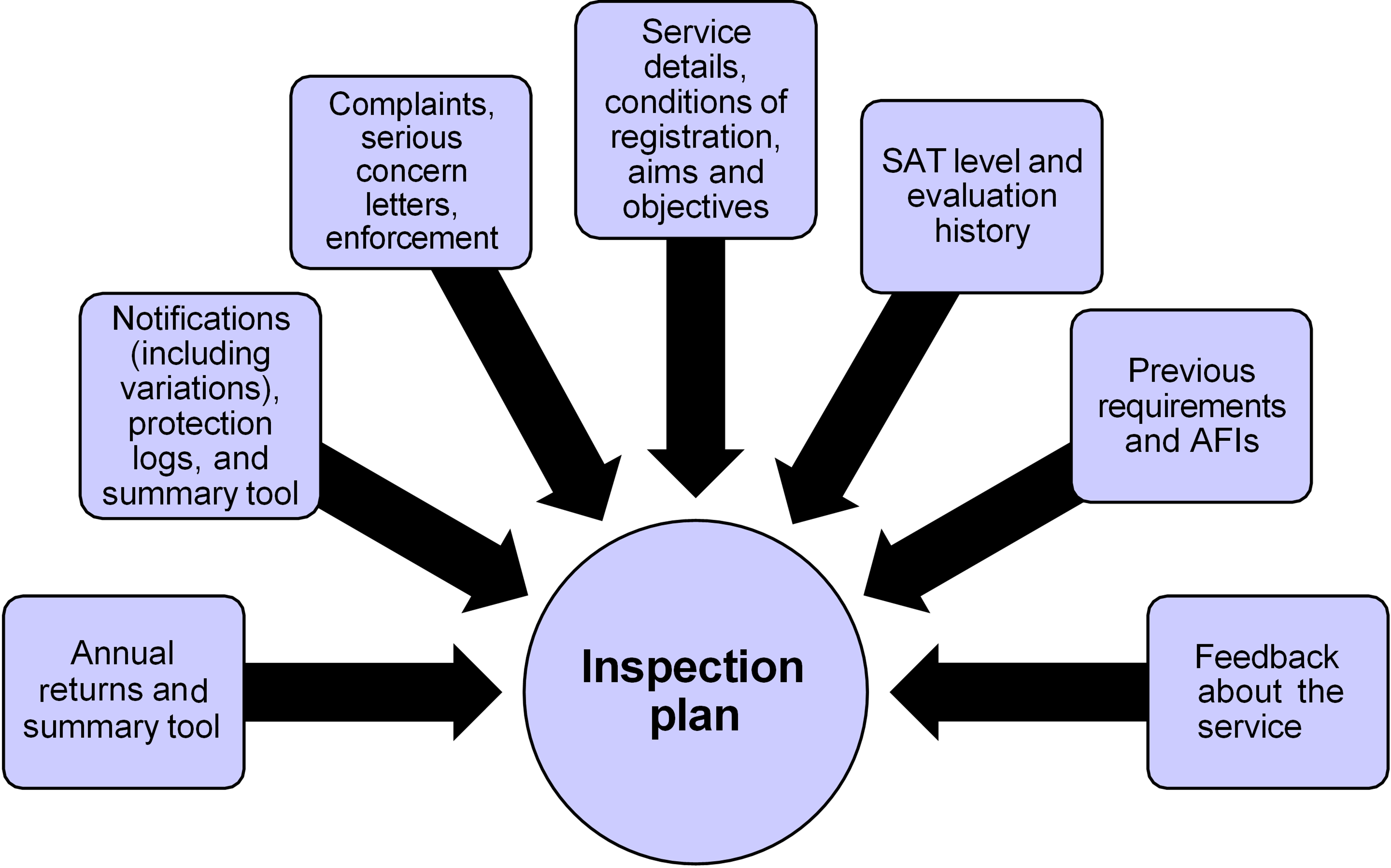
Before an inspection, inspectors will review the data and information we hold about a service and its performance. This helps to determine the type and timing of the inspection and the areas of the quality frameworks we will focus on. The sources of information may include our internal registration report, the annual return, notification history, complaints or concerns and enforcement information, external agency data, information and risk, any recent variations to the conditions of registration and evaluation history.
The graphic below shows some of the sources of data and information, but this list is not exhaustive.
Timing
When planning an inspection, we take account of the way that a particular service operates. For example, we will visit services at different times (early morning, evening, weekends and holiday periods) to observe how the service operates at different times and maximise opportunities to meet people using services and their carers. This gives us a good understanding of the way the service is staffed, managed and delivered. Services should ensure their teams feel informed and comfortable with inspectors visiting at different times, including when managers are not present.
Care Standard Questionnaires (CSQs)
Before an inspection, services will receive links to electronic Care Standards Questionnaires (eCSQs) through the eForms system. Services should ensure these links are shared with people experiencing care, their families and carers, staff and key stakeholders in advance of the inspection. Inspectors may also share eCSQ links during the inspection to make sure people have the opportunity to give feedback about the service.
Along with the eCSQs links, services will receive a letter (sometimes called a poster) containing QR codes. These can be printed and displayed or made available on a tablet or device. This enables people to give feedback before or during the inspection.
Paper CSQs will continue to be available for care at home services, care homes for adults and older people and childminders.
5 Who carries out the inspection?
The lead inspector and co-workers
Every inspection has a lead inspector. They are responsible for planning and carrying out the inspection and writing the report. They may also have a co-worker or a team of co-workers depending on their specialist skills and size of the service. Co-workers will support the lead inspector during planning, when gathering evidence, speaking with people and staff, and will take part in discussions about evaluations of the service and feedback with the lead inspector.
Inspection volunteers
Where appropriate, an inspection volunteer may join the inspection team. Inspection volunteers have a personal and unique experience of care. They may use or have used services themselves, or they may have experience of caring for someone who uses care services.
Inspection volunteers may be involved in inspections in different ways, such as:
talking to individuals or groups of people using a service, their family, friends or representatives during inspections
attending focus groups
undertaking telephone interviews
attending groups for people using a service, or carers’ groups.
Shadowing
Sometimes an individual may accompany an inspector during an inspection visit for learning or development purposes. This is known as shadowing. Shadowing may take place, for example, when an inspector is new to inspection work, returning after a period of absence, or becoming familiar with a service type that is new to their caseload. Shadowing may also involve colleagues from other teams within the Care Inspectorate who are learning about inspection processes to support their role.
All shadowing arrangements are subject to internal procedures. The lead inspector will ensure that confidentiality and privacy are maintained at all times, particularly during discussions with people using services or staff, and when accessing confidential information. Expectations will also be clearly explained to the person shadowing.
6 The inspection visit
The start of the visit
The exact activities and the order in which they are undertaken will vary depending on the service but generally, at the start of the inspection, the lead inspector will:
introduce themselves on arrival and inform the manager or senior member of staff in charge that they are in the service
agree key contacts for the day, including who is the most senior person available
let the person in charge know that they can contact a colleague or someone more senior in their organisation if they need support
have a tour or walk around of the premises (if it is a premises-based service), so they can introduce themselves (and any co-workers) to everyone
prioritise speaking with people using the service to keep them at the centre of the inspection, before moving into discussions with the management team
not disrupt the plans for the day and be mindful of people’s routines
have a brief discussion with the manager or the senior member of staff in charge to outline what the inspection will involve, including which quality indicators/key questions are being evaluated
if the manager/senior has not experienced an inspection before, they will explain the process in more detail and check their understanding
ask about any key achievements and areas of improvement since the last inspection and priorities going forward
listen to any concerns the manager, provider or staff have about the inspection process
enquire about any persons who have any significant health and wellbeing concerns which we may need to be sensitive around or which may be exacerbated or adversely affected by the inspection
request a copy of the most recent service improvement / development plan
talk through the evidence they would like collated for the inspection and agree how this will be shared / accessed (for example information stored electronically or at a different office base)
ask for contact details of key stakeholders/visiting professionals and the best way to contact people using the service
explain the feedback process and talk about who should attend the formal feedback meeting and also ask who they can give feedback to each day
encourage the manager/senior to approach inspectors at any time and ask them to share this message with people, staff and visitors.
If, at any point in the inspection process, those involved feel overwhelmed, distressed or overly anxious, a request can be made for the inspection to be paused. A request to pause can be made by either the inspector or the manager/senior staff member. This request can mean different things depending on the situation and needs of the individuals involved. It may be a call to stop, acknowledge some of the difficulties being presented/experienced, discuss these and agree the best way forward. This may be:
agreeing to a short break before resuming the inspection
agreeing the need to involve other people to support the manager
pausing the inspection until the following day
discussing the need to reschedule aspects of the inspection and/or the feedback meeting to ensure appropriate support is available (for the inspector or the service).
In very exceptional circumstances an inspection may be paused for up to five days. Any decision to pause inspection activities must be taken in consultation with Care Inspectorate service managers. Where the service is part of a larger provider, the provider will also be contacted to discuss the request to pause including arrangements for resuming the inspection.
Pausing an inspection would not be appropriate where we are concerned for the safety and wellbeing of those using the service.
More information about our approach to scrutiny and improvement activities is available on our website.
Gathering and triangulating evidence
Inspectors will gather information under the relevant quality indicators which they will then report on. They may sample information or look in more depth depending on what is happening in the service, their observations and what people tell them.
Inspectors will always triangulate evidence to support their evaluations. This includes:
observation
talking with people
sampling documentation.
Engaging with people
Evaluating people’s experiences is a fundamental inspection activity. At the heart of the inspection, we will talk and listen to people who are using services and observe carefully how staff interact with them.
Our inspectors and inspection volunteers will speak with people using the service and their visitors, relatives / parents / carers, staff, and volunteers. We may use different ways to gather views and experiences of people, including:
face-to-face discussions and interactions (sometimes using translation apps)
questionnaires
phone calls
attending service user or relative groups that may be held during the inspection
taking part in activities or social events
emails
conversations using technology such as Microsoft Teams.
Our methods of inspection also allow us to give a voice to people in services who have not or cannot engage with us verbally.
All of our inspectors are trained to sensitively and respectfully engage with staff and people using services. Inspectors can recognise signs of distress and respond appropriately.
We have developed an easy read guide to inspections that you can share with people using your service.
Gathering views of other professionals
Inspectors may request a list of contact details for visiting professionals from the manager of the service. Where possible, we will make contact through email, phone or virtual technology where they are not visiting the service during the inspection.
Discussions with managers and staff
Inspectors will speak with a selection of staff who undertake different roles during the inspection. The number of staff we speak with will depend on the size of the service. Inspectors will alter discussion/ interview arrangements if staff have to attend to the needs of people. We can also support conversations using technology such as Microsoft Teams at a time that is most suitable to staff. All conversations will be held in private and be confidential to the inspector for the purpose of inspection (unless this includes information that indicates risk of harm where we may need to share this with the appropriate body). Inspectors will not disclose information that makes individuals identifiable. Inspectors may request contact details of staff so we can contact them.
Observation
Inspectors will observe how people are supported and cared for. We will focus on how people’s needs are met and how staff engage with them.
At most of our adult and ELC inspections, inspectors use SOFI2 (Short Observational Framework for Inspection) under license from the University of Bradford. This is an inspection tool used to form a judgement on the person’s experience of using the service.
The SOFI2 tool is designed for regulators, providing a framework to enhance the observations we already make at inspections about the wellbeing of people using the service and staff interaction with them. It is not a standalone tool - it provides a snapshot observation and can be used flexibly to record observations for an individual or a group. Our inspectors receive additional training on observation, compliance outcomes and judgements, feeding back and reporting.
You can find information about SOFI2 from Bradford University’s website.
Sampling documentation
Written information, including case records and personal plans, is an important source of evidence and will be sampled by inspectors. Inspectors must be able to easily access all relevant information for the purposes of undertaking the inspection. Providers have a duty to provide this information when requested. The size and nature of the sample will be directed by the inspector. This will be informed by the core assurance or quality indicator being evaluated and the level and nature of any identified risks. This may include, for example:
case records and personal plans
recruitment and staffing records
incident reports and records of accidents or adverse events
medication records and management systems
quality assurance records, including audit and monitoring processes
service improvement, action or development plans linked to quality assurance and/or self-evaluation activity.
Where services are using electronic or digital systems, care should be taken to ensure the appropriate security controls are in place to maintain the integrity, availability and confidentiality of information and supporting systems. Services should, wherever possible, provide a suitable device and an appropriate user account for inspectors to use during the inspection. This does not mean that inspectors require unrestricted access, but you must have a means of providing access to view any information we require for the purposes of inspection.
It is expected that access will be provided in alignment with your own information security policies and control procedures. For example, this could include setting up a separate ‘read-only’ guest account for inspectors to use for the period of the inspection. Where guest account access is permitted, inspectors may be able to use their Care Inspectorate device to access your information systems. This is subject to your own security policies and controls. When inspectors use their Care Inspectorate device to view your information, they will do this from within your premises to support an opportunity to review and discuss the information provided.
Where you are not able to provide the inspector with access to your information system, you should speak with the inspector to agree how information is going to be shared and plan for how information will be made accessible going forward. Inspectors will also want to know how people or their families are supported to access electronic or digital systems to review information relevant to them.
Services may provide copies of information requested, through email, where these are not easily accessible, in either paper format or through the providers own information systems.
If records are held in hard copy at a central location, providers will need to arrange for records to be securely transported to the service, or scanned and emailed as appropriate. In all instances our inspectors will be responsible for identifying the relevant documents we need to sample. If you are not able to provide the information requested, the inspection process will proceed on the basis that the information does not exist.
Inspectors will delete copies of any documents emailed to them that contain personal information as soon as they have been reviewed, in line with the Care Inspectorate’s core privacy notice.
Recruitment records
During inspections, inspectors will assess whether services follow recruitment practices that help keep people using services safe. This assessment forms part of the core assurances and may also be considered under relevant quality indicators within our quality improvement frameworks.
Our guidance on records services must keep sets out the recruitment records that services are expected to hold and make available when requested during an inspection. Where providers use centralised recruitment arrangements, they must have clear processes in place to allow inspectors timely access to staff recruitment information.
We recognise that providers have responsibilities under GDPR and related data protection legislation. Inspectors should not be given unrestricted access to full HR or personnel files where these contain personal information that is not relevant to the inspection purposes.
We have developed a recruitment self-evaluation tool to help providers review and strengthen their safer recruitment practices. This can be used alongside our quality frameworks, Safer Recruitment Through Better Recruitment and other good practice recruitment guidance.
Recording evidence
Inspectors will record all evidence and evaluations in a notebook during the inspection. The notebook is the legal written record which captures key aspects of the inspection process. The inspection notebook is recorded electronically, therefore inspectors will carry their IT equipment with them throughout the inspection. Inspectors may take photographs to support their evaluations. Any evidence we record will be stored and disposed of in line with our GDPR policies.
Serious concern letters
Where there is an immediate risk to the health, safety, or wellbeing of people experiencing care at an inspection, or emergency enforcement procedures are considered, inspectors will address this with the manager and/or provider.
If urgent improvements need to be made, we may issue a Serious concern letter to the provider (sometimes referred to as a letter of serious concern). This will contain requirements detailing the improvements that must be made. Timescales for a Serious concern letter are typically no more than 48 hours, or 72 hours where this falls over a weekend or on a day when the service is closed.
In situations where serious risks to people’s lives, health or wellbeing are not being effectively managed, and we are not confident the service can address them, we may move directly to enforcement action rather than issuing a Serious Concern letter.
If remedial action is taken immediately while the inspection is in progress, and the inspector is satisfied that this has reduced the presented risk, this will be reflected in the inspection report. Where the serious concerns are not addressed during the inspection, we will consider further regulatory action.
7 Evaluations and Feedback
Ongoing feedback to the service
Inspectors will periodically update the manager or senior staff on their findings so that there are no surprises at the formal feedback meeting. Where concerns are identified, particularly when the concern could result in risk for people, the inspector will alert the service so that they can take action immediately.
Ongoing professional dialogue during the inspection is used to recognise areas of good practice and any areas that need to improve. This allows the inspector to confirm their assessment and allows the manager to provide context or additional information.
If the inspection continues over more than one day, a time will be agreed to give brief summary feedback at the conclusion of each day.
If services have concerns about the way the inspection is being undertaken or the conduct of any of the inspection team, this should be raised as soon as possible. Initial concerns should be raised directly with the lead inspector who will be able to share the contact details for their team manager where further discussions are required. Alternatively, you can call our contact centre who will be able to give you contact details for the relevant team manager.
Making our evaluation
Once we have completed the inspection visit, we analyse and evaluate all the evidence gathered and carefully consider the quality illustrations from the relevant quality framework. We apply balanced professional judgement to decide on the appropriate evaluation from the grading guidance for the quality indicator.
The grading guidance is available in Appendix A (for Adults and CYP) and Appendix B (for ELC). We also have tools to support inspectors with consistent and proportionate decision-making.
One of these tools is the Proportionate Outcome Evaluation Tool (POET). The tool is used to consider the risks, or potential risks, to people’s outcomes, alongside the service’s regulatory history, current performance, and its capacity and willingness to improve. This helps to make sure that the evaluations (grades) we award are evidence-based and proportionate.
We will provide an overall evaluation for each of the key questions/headings inspected, using the six-point scale from excellent (6) to unsatisfactory (1).
Where we inspect more than one quality indicator per key question/heading, the overall evaluation for the key question/heading will be the lower of the quality indicators for that specific key question.
Making requirements and areas for improvement
Where improvements are necessary, the inspector may use requirements or areas for improvement linked to the Health and Social Care Standards to support improvement within the service. Requirements are based on regulations and will always include a timescale for implementation. Areas for improvement may also be based on good practice guidance.
Inspectors also use the POET when deciding whether to make requirements or areas for improvement. This helps ensure the most appropriate assurance and improvement approach is used to improve outcomes for people.
Providing feedback
Feedback to people who use services and carers
It may be appropriate for us to offer direct verbal feedback to people who use services and their carers. This provides an opportunity to assure them that their views have been fully considered alongside other evidence gathered and to tell them how these have influenced our judgements and how we propose to reflect them in the report.
As part of our commitment to keeping The Promise, we will continue to test different methods of formally feeding back to children and young people in a small number of services.
The feedback meeting
We support and encourage open professional dialogue throughout the inspection process. Observations and findings will be shared during the inspection. At the end of the inspection, we will provide formal feedback.
The formal feedback meeting provides the opportunity to present our inspection findings and initial evaluations. If the evaluations change once the inspection team write the draft report, this will be shared with the service before the draft report is issued. Feedback also provides the manager, senior member of staff or provider with an opportunity to present additional information, seek clarification or raise any challenges to the evaluations made by the inspector.
We will agree a suitable time for feedback with the manager and agree who will be present at the meeting. Providers are encouraged to ensure that the appropriate people are invited, specifically those directly involved in or aware of the inspection. Providers should also take full notes of the feedback shared. Evaluations (grades) presented at the feedback meeting are provisional and subject to moderation and validation.
We aim for our feedback to:
use clear, simple language, be constructive and given with the aim of supporting improvement
be focused on strengths and highlight areas of good practice
identify areas for improvement and the factors that contribute to them
clearly explain the impact that areas of poor performance are having, or may have, on the quality of life and outcomes for people using services
signpost to good practice guidance and improvement resources
include the evaluations being awarded (even where these may be provisional) by referring to the grading framework
consider the context in which staff are operating and share findings in a constructive way to encourage ownership and learning to take place.
The inspector will listen to any points the provider raises and consider any additional evidence they offer at this time.
In order to have a supportive feedback meeting with opportunities for professional dialogue, it is important to consider who should attend the meeting. While we recognise that managers may wish to have provider representatives present for support, we cannot use the feedback meeting to repeat the ongoing professional dialogue that has taken place during the inspection. This is particularly important if people attending the feedback meeting have not been present throughout the inspection. If people are attending feedback who have not been present during the inspection, the manager or other staff should ensure they are aware of the ongoing feedback and findings already shared during the inspection in advance.
It is also helpful to limit the number of people at feedback to those who have a direct operational need to be there. This helps ensure that we use this dedicated time effectively. It will allow us to provide feedback on the inspection findings, listen to your response and give consideration to any points you raise. This can be more difficult if there are a number of people with a range of responsibilities present. In exceptional circumstances, if the inspector is not comfortable with the number or range of people attending feedback, they may ask for this to be reconsidered. This may mean we need to change the agreed feedback time, which may result in a delay to the conclusion of the inspection.
If you are working with a local authority or health and social care partnership, you may also choose to have a representative of these bodies present for feedback. This is matter for the manager and provider to agree with the external body.
Delivering difficult messages
It is our responsibility as a regulator to ensure the safety and wellbeing of people using care services. At times, this can involve delivering difficult messages about the quality of people’s experiences and the care being provided. If we have identified areas of concern and are making requirements or considering enforcement action, we will engage sensitively and supportively with the management team/provider. We will work in the spirit of collaboration to clarify and agree the actions required to support improvement and keep people safe.
As you will have had ongoing professional dialogue and discussed our emerging findings with your inspector throughout the inspection, the feedback and conclusions on inspection findings should not be unexpected.
We encourage managers to have organisational support at feedback to ensure they feel at ease.
8 After the inspection
The inspection report
The inspection report is our opportunity to communicate our findings to the public. People may use our reports to help them make decisions about care services. It is therefore important we communicate as clearly as possible about what we found and the impact the service is having on the lives of people receiving care and support.
Draft reports are sent to the provider through our e-forms system. The report will be issued within 15 working days from the date of the feedback session.
The error response form
We have an error response procedure to ensure we act fairly and are accountable. This process lets providers see and comment on the draft report as well as communicate any inaccuracies or discrepancies before the report is finalised and published on our website.
Providers can request a further discussion with the lead inspector at any time during the inspection process if they need further clarification in relation to ongoing or final feedback shared. This can be particularly helpful if there are aspects of the draft report that do not align with the provider’s recollection of the feedback shared at the end of the inspection.
When completing the error response form, providers are asked to ‘describe the error’ and a ‘proposed correction’ under the relevant section of the report. Providers should create a new section for each point they would like us to consider. Additional evidence documents can be uploaded to the error response form but the reasons for their inclusion should be clearly explained within the ‘describe the error’ section.
There are certain circumstances in which we may accept providers proposed correction and amend our report. These include where our review of the evidence shows that:
the report contains factual inaccuracies, such as names, times, dates and places
the report does not reflect an accurate representation of the evidence
evaluations (grades) are based on inaccuracies or discrepancies in the evidence
evaluations (grades) can be demonstrated to be unjustified as they are not reflective of the relevant evidence (which is not in dispute).
The provider must return the error response form within 10 working days so that we can review the information provided. We will assess if changes or adjustments are needed and update the report if necessary. The provider will receive a letter stating the evidence we considered, the outcome and if any changes have been made. The report will then be finalised and published on our website. More information about the error response process can be found on our website.
The action plan
Action plans are automatically made available to providers once the report has been finalised. Providers must respond to any requirements and areas for improvement made and submit an action plan to the Care Inspectorate within the required timescale.
We would expect the action plan to detail how the requirements and areas for improvement will be met, by whom and when. It must clearly set out what the service will do to improve. The plan should be SMART – Specific, Measured, Agreed, Realistic and Time Specific.
If the action plan does not address the requirements and areas for improvement, detailed within the inspection report, providers will be asked to update it.
Follow-up inspections
Follow-up inspections are carried out where data and information, previous grading/ evaluations in the same inspection year and risk assessment highlights a need for further inspection. A follow-up inspection focuses on the requirements and areas for improvement made during previous scrutiny activities (such as inspections and complaint investigations) and evaluates how the service has addressed these to improve outcomes.
Re-evaluation out with inspections
Evaluation is a continuous process which means there may be times when we award new evaluations (grades) to a service out with the usual inspection cycle. These may include:
in response to notifications or intelligence about serious incidents in care services
following complaint investigations where we have upheld complaints.
We may decide to re-evaluate a service where there is evidence that the current evaluations (grades) no longer reflect the performance of the service and the outcomes experienced by people. This is to ensure that accurate grading information is available for people to access via our website.
Any decisions to re-evaluate (re-grade) a service will be discussed with the registered manager for the service and confirmed in writing. If providers disagree with our decision, they can request a review using the ‘Re‑evaluation review request’ process.
Post-inspection support
When we have concluded our inspection or follow-up inspection, we encourage services to remain engaged with us. We are committed to working in partnership to support improvement in services, which may take different forms. For example, we run formal activities such as the early learning and childcare improvement programme, Care Home Improvement Project (CHIP), and more specialist support with issues such as Digital social care and Anne’s law.
You may also find it helpful to have further discussions with your inspector, particularly if you are working on improvements that we have identified in our inspection report. In some instances, we may be able to provide further input to help with improvement. This might include further collaborative work with your inspector or signposting to improvement resources. Our improvement resources can also be used to plan for and implement improvements identified during service’s own quality assurance or self-evaluation processes.
9 Feedback on the inspection process
Inspection Satisfaction Questionnaires (ISQs)
As part of our commitment to learning from inspection experiences and improving how we carry out inspections, services are invited to provide feedback through Inspection Satisfaction Questionnaires (ISQs). During inspection visits, paper ISQs are offered to a small number of people experiencing care and their relatives and carers so they can provide feedback about the inspection process.
After the inspection report has been finalised, services will receive an email with a link and access details to complete the electronic Inspection Satisfaction Questionnaire (eISQ). The eISQ can be completed by providers, managers and staff.
Feedback from ISQs helps us understand what worked well and identify where we can improve our inspection approach. We value the time taken to share feedback and use it to inform how we carry out inspections.
Complaints
Our policy for complaints about the Care Inspectorate reflects our organisational commitment to valuing and learning from complaints. This supports our aim to resolve dissatisfaction at the earliest opportunity by conducting thorough, impartial and fair examinations of complaints so that, where appropriate, evidence-based decisions on the facts of the case can be made.
We always welcome feedback on our inspection processes. You can contact your inspector directly. Alternatively, call us on 0345 600 9527 or email enquiries@careinspectorate.gov.scot where one of our advisers will direct you to the appropriate person.
Appendices
Excellent (6) Outstanding or sector leading
An evaluation of excellent describes performance which is sector leading and supports experiences and outcomes for people which are of outstandingly high quality. There is a demonstrable track record of innovative, effective practice and/or very high quality performance across a wide range of its activities and from which others could learn. We can be confident that excellent performance is sustainable and that it will be maintained.
Very good (5) Major strengths
An evaluation of very good will apply to performance that demonstrates major strengths in supporting positive outcomes for people. There are very few areas for improvement. Those that do exist will have minimal adverse impact on people’s experiences and outcomes. While opportunities are taken to strive for excellence within a culture of continuous improvement, performance evaluated as very good does not require significant adjustment.
Good (4) Important strengths, within some areas for improvement
An evaluation of good applies to performance where there is a number of important strengths which, taken together, clearly outweigh areas for improvement. The strengths will have a significant positive impact on people’s experiences and outcomes. However, improvements are needed to maximise wellbeing and ensure that people consistently have experiences and outcomes which are as positive as possible.
Adequate (3) Strengths just outweigh weaknesses
An evaluation of adequate applies where there are some strengths, but these just outweigh weaknesses. Strengths may still have a positive impact but the likelihood of achieving positive experiences and outcomes for people is reduced significantly because key areas of performance need to improve. Performance which is evaluated as adequate may be tolerable in particular circumstances, such as where a service or partnership is not yet fully established, or in the midst of major transition. However, continued performance at adequate level is not acceptable. Improvements must be made by building on strengths while addressing those elements that are not contributing to positive experiences and outcomes for people.
Weak (2) Important weaknesses, priority action required
An evaluation of weak will apply to performance in which strengths can be identified but these are outweighed or compromised by significant weaknesses. The weaknesses, either individually or when added together, substantially affect people’s experiences or outcomes. Without improvement as a matter of priority, the welfare or safety of people may be compromised, or their critical needs not met. Weak performance requires action in the form of structured and planned improvement by the provider or partnership with a mechanism to demonstrate clearly that sustainable improvements have been made.
Unsatisfactory (1) Major weaknesses, urgent remedial action required
An evaluation of unsatisfactory will apply when there are major weaknesses in critical aspects of performance which require immediate remedial action to improve experiences and outcomes for people. It is likely that people’s welfare or safety will be compromised by risks which cannot be tolerated. Those accountable for carrying out the necessary actions for improvement must do so as a matter of urgency, to ensure that people are protected, and their wellbeing improves without delay.
The six-point scale is a tool for evaluating the quality indicators. It is used by HM Inspectors and the Care Inspectorate for reporting on the outcomes of inspections. Local authorities and other governing bodies may choose to use it for the purpose of national and/or local benchmarking across a number of settings. It is not necessary for individual settings to measure themselves against the six-point scale although they may choose to do so to help evaluate and understand their performance.
Level: 6 Excellent
This means that aspects of the setting’s work are outstanding and sector leading. The experiences and achievements of all children are of a very high quality. This represents an outstanding standard of provision which exemplifies exceptional best practice. It is based on achieving equity and inclusion. Settings show a deep professional understanding which is worth sharing to support sector-wide improvement. It implies that very high levels of performance are sustainable and will be maintained.
Level: 5 Very good
This means that there are major strengths in this aspect of the setting’s work. There are very few areas for improvement, and any that do exist do not significantly diminish children’s experiences. An evaluation of very good represents a high standard of provision for all children. There is an expectation that the setting will make continued use of self-evaluation to plan further improvements. The setting will work towards improving provision and strive to raise performance to excellent.
Level: 4 Good
This means that there are important strengths within the setting’s work; however, some aspects could benefit from improvement. The strengths have a significantly positive impact on almost all children. The quality of experiences is diminished in some way by aspects in which improvement would be beneficial. The setting should seek to improve further the areas of important strength and also take action to address the areas for improvement.
Level: 3 Satisfactory/adequate
This means that strengths in this aspect of work just outweigh the weaknesses. These strengths may have a positive impact on children’s experiences; however, children only access a basic level of provision, which constrains the overall quality of their experiences. Practice at this level may be tolerable in particular circumstances, for example, where a service or partnership is not yet established or is in the midst of major changes. Continued performance at this level should not be considered acceptable in the long term. The setting needs to build on their strengths to improve practice, creating positive experiences and better outcomes for all.
Level: 2 Weak
This means that there are some strengths, but there are important weaknesses within this aspect of the setting’s work. These weaknesses, either individually or collectively, are sufficient to diminish children’s experiences. Improvements must be made as a matter of priority. Without improvement the welfare, safety or learning and development of children may be compromised, or their individual needs not met. Weak performance requires prompt improvement action. Structured and sustainable improvements must be prioritised.
Level: 1 Unsatisfactory
This means there are major weaknesses in critical aspects of performance which require immediate, remedial action to improve experiences and outcomes for children. These weaknesses may relate to care, play or learning, and are likely to result in children’s welfare, safety, or learning being compromised by risks or deficiencies that cannot be tolerated. Those accountable for carrying out the necessary actions for improvement must do so as a matter of urgency. Children must be protected and their safety, wellbeing and progress in learning and development improved. This will require focused support from senior managers in planning and carrying out the necessary actions to effect improvement. This will usually involve working alongside other staff in other settings or agencies.